C21 Canada

  • Home
  • About C21
    • Organizational Goal
    • Press Releases
    • Advisory Council
    • Secretariat
    • CEO Academy
    • CIO Alliance
    • Get Involved
    • Contact
  • Partners
  • Blog
    • C21 Canada Webinar Series: Future of AI in K12 Use Case Project Leadership Insights
    • C21 Canada Webinar Series: The Future of AI in K12 Education
    • C21 Canada 10th Anniversary Webinar Series
    • C21 Canada 2020/2021 School Year Podcast Series
  • Curation Space
    • CEO Academy Login
    • C21 Board Login
  • C21 Canada Publications
    • C21 CANADA AI TASKFORCE REPORT
    • The Future of AI in K12 Education Report
    • School Beyond COVID-19
    • C21 Canada Research
    • Resources
    • Parent Guide
    • Spiral Playbook
    • Shifting Minds
    • A COVID-19 LEADER PLAYBOOK FOR SURVIVING AND THRIVING
  • AI Use Cases
    • Spring 2025
    • Fall 2024

December 11, 2013 by admin

The Canadian Skills Mismatch: DEMOGRAPHIC IMPLICATIONS

By: Dr. Rick Miner on behalf of C21 Canada

INTRODUCTION

According to David Foot and Daniel Stoffman, two internationally renowned demographers, “Demographics explain about two-thirds of everything.” (Boom, Bust & Echo, page 2).  Yet, in the case of Canada’s labour market future, one might reasonably push that estimate into the 80th percentile using the 2010 and 2012 reports published by Miner, in the People Without Jobs Jobs Without People series, as the basis for the change.  These reports investigated the impact of the baby boomer generation exiting the workforce resulting in significant labour force shortages.

DEMOGRAPHIC PROFILE

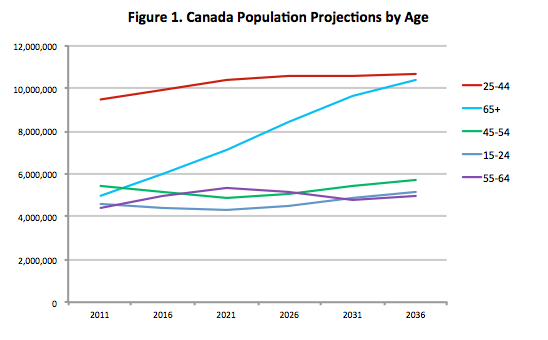
Using Statistics Canada projections, Figure 1 provides a visual image of how Canada’s demographic profile will change as the number and proportion of the population 65 and older increases while the primary working age group (25-44) remains relatively stable.

graph fig. 1

LABOUR FORCE BALANCE 2010

Assuming our labour force size will need to increase in rough proportion to our overall population growth, we will soon experience significant labour force shortages resulting from the fact that retired baby boomers have significantly lower labour force participation rates, and, given current trends, will not be able to be replaced fast enough by members of the younger generations.

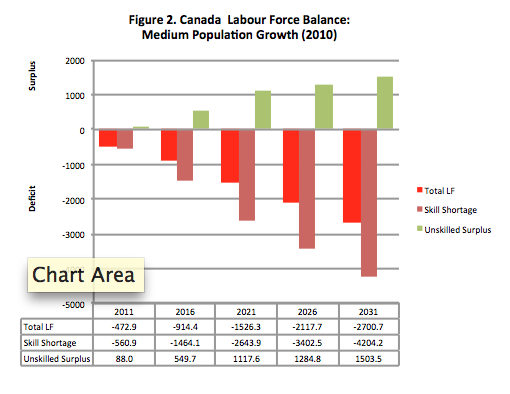
These earlier reports projected a Canadian labour force shortage of 2.7 million and a skills shortage of 4.2 million by 2031 (Figure 2).

Graph fig.2

CHANGES SINCE 2010

Since the publication of these reports a number of dramatic shifts have occurred that warrant a re-analysis of the earlier findings.  While the ultimate impact of some changes may not be known for a while, it is worth considering their implications.  The changes of most significant note are:

  • Labour force participation rates for those 55 and older have increased (largely attributed to our recent economic difficulties).
  • The Federal Government has established a number of new immigration programs (Canadian Experience Class, Foreign Skilled Trade Worker Program and the Foreign Skilled Worker Program) targeting younger immigrants who have employment skills and/or Canadian education and training specifically geared to our labour market needs which should increase their labour force participation rates.
  • Labour Force demand projections have decreased.
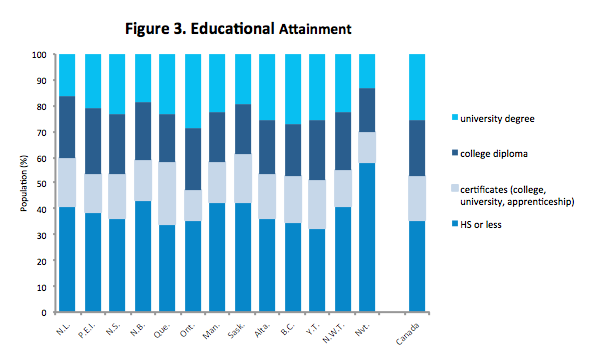
  • Recent Statistics Canada data, using 2011 census results, show Canada has achieved educational attainment levels higher than previously projected (Figure 3).

Graph fig.3Proposed changes in retirement benefit provisions, moving eligibility from 65 to 67, should keep people in the work force longer.

  • New investments have been made in increasing the educational opportunities for aboriginals and persons with disabilities which should result in a larger and more skilled work force.

LABOUR FORCE BALANCE:  A RE-ANALYSIS

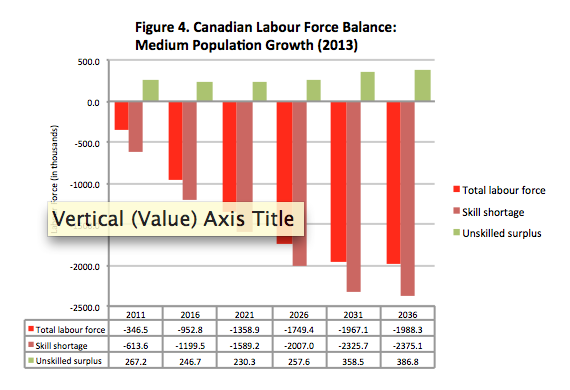
Considering these changes and other more current information, a re-analysis of the data was completed and the results are shown in Figure 4.  As can be seen, we still have both a labour and a skill shortage, but the situation has improved.

graph fig. 4

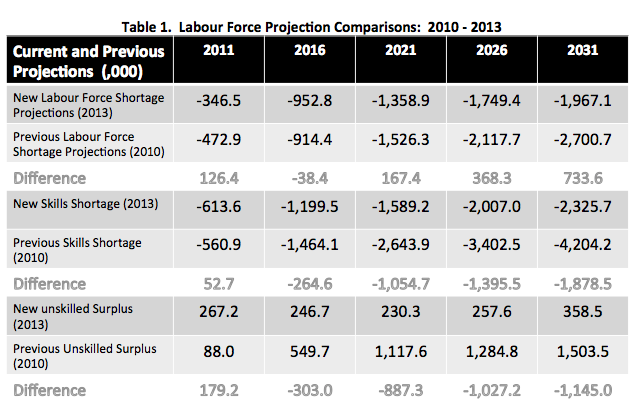
Table 1: Labour Force Projection Comparisons: 2010 -2013 provides a comparison between the earlier and this new data.  The projected labour force shortages, skill shortages and projected increased levels of unemployment have improved.  However, shortages still exist and they are far from trivial.


RoundTable1

Rather than needing an additional 2.7 million workers by 2031 the shortage is now forecasted to be a little less than 2 million.  Similarly, projected skills shortages drop significantly from 4.2 million to 2.3 million because of increased educational attainment levels.  While the changes are encouraging, we must understand that we have major skill and labour force shortages forthcoming.

In fact, we have a two-headed problem to address in that we not only need more workers, but we need them to have the right skill sets.  To increase the size of our work force, it is best to look for employment growth opportunities among those who have historically been under represented in the work force.  These are immigrants, aboriginals, persons with disabilities, women, youth and older workers.  Yet, we must be cognizant of the fact that these increases need to correspond to areas where skill shortages exist not in areas where there is a surplus.  It was earlier assumed that simply having an educational attainment level beyond high school would be sufficient to meet businesses skill requirements.  However, as will be discussed later, this assumption was far too simplistic, and will not resolve the skills mismatch problem that does and will exist.

SKILLS MISMATCH

While the debate over the existence or non-existence of a skills mismatch (skills shortage) is taking on epic proportions, many are asking a far too simplistic question (Do supply-demand mismatches currently exist?).  Those on the “yes side” include IBM, Canadian Chamber of Commerce, CIBC, a majority of the sector councils, and Engineers Canada to name a few.  They support their position by providing estimates showing large projected labour shortages that far exceed existing supply.

Those on the “no side”, tend to concentrate on existing economic data looking at unemployment rates compared to job vacancy rates that show significantly fewer vacancies than those who are unemployed.  The assumption here is that if there were shortages then the number of job vacancies would be significantly higher, in proportional terms, to the number of unemployed.  Alternatively, they look at occupations in high demand and determine the extent to which wages have increased using the hypothesis that large wage growth indicates a labour shortage (law of supply and demand).  While there has been some wage growth in high demand areas the numbers have not been huge. Both approaches are fairly classical economic analysis techniques.  Using them one could conclude that there is not now a labour/skills shortage.

It is less clear that these two economic approaches are able to get at the dynamics of our labour market situation for the following reasons.  First, the orientation is focused more on the here and now and less so on the future.  As has been shown earlier in this report (Table 1), we have experienced some short term labour force relief but our demographic reality will get progressively worse as more and more baby boomers enter retirement.

Second, a here and now analysis must consider the significant increase in the entry of temporary foreign workers to Canada, reported to be over 300,000 in 2012, which, in part, masks the labour shortage.  Third, the Labour Force Participation Rate of workers 55 and older has increased which lowers the labour force shortage, which is good, but they will not stay in the work force “indefinitely”, and this reality must be considered.

Given the shortage projections provided by industry and the results of this analysis, one is inclined to accept that in 2011 there was not a major labour shortage but now (2013) one exists and evidence shows that the situation will get progressively worse.  In fact, we actually have multiple skill mismatches.

These are

  • Supply-demand mismatches which tends to be the focus of the current debate.
  • A geographical mismatch (skills in the wrong place) which is becoming increasingly evident as mega projects emerge (oil sands in Alberta, LNG terminals in Northern BC, mine expansions in BC, the Yukon and Ontario, natural resource projects in Manitoba and Saskatchewan, energy projects in Labrador and Quebec, ship building in Vancouver, Halifax and Montreal, and an Eastern pipeline headed to Saint John, NB).
  • An underemployment (over skilled) reality particularly among our youth.  A recent study by the Certified General Accounts of Canada found that 24.5% of recent university graduates were underemployed.  A similar study in the United States found the rate to be 48%.
  • Finally, we have another mismatch where the skills of the workers are less than those required of their positions (under skilled/overemployment).

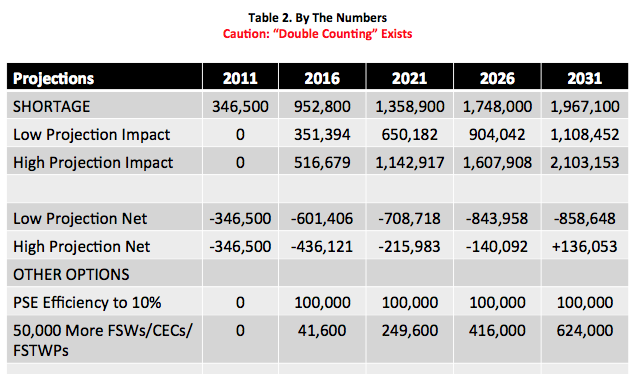
So, in reality, we have multiple mismatches requiring a variety of solutions.  First and foremost, we need to increase the overall size of our work force.  To do this, as mentioned previously but worth repeating, we need to concentrate our efforts on increasing Labour Force Participations Rates (LFPRs) among under represented groups.  Using a “what if analysis”, fully detailed in a forthcoming report by Miner (The Great Canadian Skills Mismatch:  People Without Jobs Jobs Without People and MORE), Table 2: By the Numbers shows that with even modest levels of growth in each designated group, we could add another 1.1 million people to the work force by 2031 thus reduction our labour shortage to 858 thousand.

RoundTable2

To achieve this would necessitate success in implementing the new immigration programs, improving aboriginal LFPRs to the national average by 2031, reducing the LFPR gap for persons with disabilities by 25% by 2031, reducing the female LFPR gap by 50% by 2031, achieving LFPRs for older workers equal to the current United States averages by 2026, and improving post-secondary efficiencies by 5% by 2016.

The labour force shortfall could be reduced to almost a breakeven point if we were to increase our immigration quota by 50,000, concentrating on younger better skilled workers.

Table 2: By the Numbers also shows the impact of more aggressive objectives in each area of interest.  Admittedly these changes will not be automatic and will require some investments, but we need to make them or the consequences will be dire. 

RECOMMENDATIONS

So our numerical shortage is solvable but we still need to avoid the skills mismatches by having more of the right people with the right skills in the right place at the right time.  To do this, to get the right skill matches, we need to make a number of significant changes.  Of particular note are the following:

  • We need to drastically improve our Labour Market Information System.  The movement to the National Household Survey appears to have had a negative effect on the validity of our data given the significantly lower response rate (68% to 93%).  Even without this problem, we face poor educational achievement data which makes it impossible to accurately tie educational attainment to economic outcomes.  This makes it difficult to know what resources we have available and how much we need.
  • We need a national education and training strategy.  To assume that all provinces will engage in educational and training initiatives that are in the best interest of the country is somewhere between naïve and simplistic.  The original federal-provincial agreement around educational responsibilities in 1867 had little to do with the value of post-secondary education but rather the role of religion.  Being the only G-7 country without a national education strategy should be instructive.
  • Career Counselling, assuming we have some good data to convey, should be “mandatory” for all high school students (perhaps even earlier), their parents, teachers and administrators.  In addition, it should be used and widely available at colleges, universities and polytechnics.

A variety of college, polytechnic and university changes need to occur.  Of particular note are:

1) An increase in coop and intern positions,

2) a restructuring of academic programs such that the applied portion of the program occurs at the end.

3) Redesigning programs so students can delay their specialization (concentration/major) as long as possible to better align their studies to labour market demands.

4) Increase college/polytechnic enrolments by “redirecting” university enrolments to better align the educational/training requirements projected in the future.

5) The establishment of more joint university-college programs with the applied (college/polytechnic) portion of the program occurring at the end.

6) Dissuade enrolment in programs that have limited employment potential given existing labour force demand projections.

7) Grow apprenticeship programs and enrolments.

Business need to get off the sidelines and become more active participants in the whole area of education and training.  Aside from supporting more coop and intern opportunities, they need to:

1) provide targeted financial support in areas where they expect increased job growth.

2) Improve hiring practices concentrating more on competencies than credentials.

3) Begin expanding on-the-job training programs to help individuals transition from school to work.

4) Be more forthcoming about actual and anticipated job growth.  It is recognized this may require some form of confidential “disclosure” to improve data validity.

Governments, aside from also being an employer, also have a critical role to play.  They need to:

1) disproportionally invest in PSE institutions that are providing the educational/training needed for the economy to expand,

2) “force” institutions to realign the balance between their research and teaching mandates which now , disproportionally, favour research,

3) work with educational institutions to help the public better understand that we do not have an educational hierarchy but rather complementary educational systems that provide different but equally valuable educational/training outcomes, and

4)  finally, invest in significantly better LMI systems both nationally and provincially.

Space limits a full discussion of the geographical and under/over employment mismatches but most of the solutions, except for some unique geographical challenges, are covered by variations of the suggestions made to address the supply-demand mismatch.  A fuller discussion of all options can be found in the forthcoming report.

CONCLUSION  

In conclusion, demographic changes, along with increased skill requirements, are the origin of our current and future labour force problems.  We will need to BOTH increase the size of our workforce and also insure that we avoid a skills mismatch by aligning our educational attainments to the work force needs that will arise.

While a number of possible solutions have been proposed, it will ultimately require a concerted and cooperative effort between business, government and educational institutions to address and resolve these problems.  Resistance to change will be encountered but a solution to these problems will give Canada a significant economic and social advantage as more and more baby boomers enter retirement.


Filed Under: Blog, C21 News, CMEC/ C21 Canada

December 4, 2013 by admin

WHAT THE OECD PISA RESULTS MEAN FOR CANADA

c21-cmec
Pictured (L to R): Robert Martellacci, David Roberts, John Kershaw, Hon. Jeff Johnson and Hon. Alan McIsaac

By John Kershaw, President of C21 Canada, and the former Deputy Minister of Education for New Brunswick

The release of the OECD’s PISA results December 3rd, 2013 http://www.oecd.org/pisa/keyfindings/pisa-2012-results.htm noted that while Canada remains as one of the world’s top performing countries, our overall achievement levels continue to trend downwards. These results are a predictor of our nation’s future prosperity. In the knowledge and digital era, where highly skilled people are the new economic and social drivers, there is legitimate cause for concern.

The implications of the PISA scores were not lost on John Manly, past federal Cabinet member and current president of the Canadian Council of Chief Executives, who was quoted in the Globe and Mail as calling the findings “a national emergency”. While others greeted the results more positively, many Canadian leaders are calling for action.

A Roundtable of Canadian business and finance leaders, convened on the same day as the release of the PISA results, underlined the call for transformative changes to Canada’s education systems. The Roundtable was a joint venture of the Council of Ministers of Education Canada (CMEC) http://www.cmec.ca/and C21 Canada www.c21canada.org . The Honourable Jeff Johnson, the Minister of Education from Alberta and current Chair of CMEC chaired the meeting. The Honourable Alan McIssac, Minister of Education and early Childhood Development joined Minister Johnson at the Roundtable, with Minister Liz Sandals, Minister of Education for Ontario, joining the gathering and sharing the podium with Minister Johnson during the event’s luncheon.

 The Roundtable participants shared a number of perspectives. Concern was expressed with the growing disengagement of high school students in their own learning. Others cited the need for an enhanced focus on the quality of teaching. The nature of the skills gap in Canada was similarly addressed. But one message was clear. All the participants are seeking national leadership and a national strategy for education to position Canada for future success.

In Canada, education is a provincial jurisdiction, and as such there is no federal department of education. Thus, it falls to CMEC to provide a national vision and framework for learning in Canada, while recognizing the jurisdictional autonomy of the individual provinces. While this constitutional reality is cited by some as a deterrent to national action, others view the de-centralization of authority as one of Canada’s greatest strengths, both in terms of allowing innovative forms of learning and teaching to emerge, and in aligning learning and skills development with regional priorities.

Notwithstanding the realities of the jurisdictional context for education in Canada, given today’s transformative economic and social realities, more than ever before there is a need for a national vision for education and skills development. And national does not necessarily mean federal. Thus it falls to CMEC to engage Canadians in the design of a 21st century inspired vision and framework for learning and skills development in Canada. Fortunately, the Chair of CMEC and his ministerial colleagues are signalling that they are up to the task. While underlining the fact that the provinces were already aware of and addressing the declining achievement levels reflected in the latest PISA results, Minister Johnson certainly did not dismiss the need for more substantive changes. In fact, it is clear that his leadership in Alberta in designing and implementing that province’s 21st century learning agenda Inspiring Education https://education.alberta.ca/department/ipr/inspiringeducation.aspx makes him well suited to leading CMEC at a defining moment in Canada.

The process of designing this national vision and framework for learning and skills development must be inclusive and collaborative by design. The Roundtable participants were clear; business, finance and other societal leaders want and need to be at the table to help design and implement the national vision and framework. And while national does not mean federal in the context of who leads the process, the process of engagement must include appropriate federal involvement and representation. The federal government does have significant responsibilities and investments that need to be aligned with those of the provinces. Lastly, given that a key success factor will be sustained effort, non political Canadian leaders will have a significant responsibility in holding successive political leaders and their governments accountable for maintaining the agreed upon course.

In today’s innovation driven economy, creative and innovative people with critical thinking skills, the ability to collaborate and adapt to changing circumstances, and thrive in a digital landscape are prerequisites to success. Many participants at the Roundtable highlighted the need for these and other 21st century competencies to be infused into the learning outcomes without losing sight of the foundational importance of and need to improve literacy, numeracy and science achievement levels. Indeed, a representative at the Roundtable from the Canadian Council of Chief Executives noted that a survey of its members showed that these “soft skills” trumped content knowledge as recruitment priorities.

C21 Canada’s Shifting Minds, A Vision and Framework for Learning in the 21st Century, calls for exactly this model of learning for Canada, and is a good place to start the discussion (www.c21caanda.org).

Long recognized as a social priority, education is increasingly being recognized as an economic imperative. Indeed, in the knowledge era, investments in education are investments in the economy. This does not necessarily mean pouring more funding into education; it does mean knowing where and how to invest, aligning education to the needs of society, and shifting your priorities and resources accordingly.

If Canada is to have sustained success in today’s innovation driven world, what we teach, and how we teach must shift to 21st century models of learning, and the nation’s investments in education aligned accordingly. The good news is that we have pockets of innovative learning and teaching excellence through-out Canada. It is time to make these practices the norm, not the exception.

If Canada is to be a global economic and social leader, we need CMEC to show national leadership in designing a vision and framework for learning and skills development in Canada. All Canadians have a stake in this exercise and a responsibility to engage. C21 Canada will continue to support CMEC as it embarks on this important and urgent task.


Filed Under: Blog

November 14, 2013 by admin

Peel Board Recognized for 21st Century Learning

digital_classroomWEB2___ContentSource: Brampton Guardian

PEEL— Peel District School Board is scheduled to be awarded for its commitment to 21st century learning.

The local school board will receive C21 Canada’s Shifting Minds National Award for distinctive achievement in the field of 21st century learning and innovation. C21 Canada is a national, not for profit organization advocating for 21st century models of learning in education.

In March 2012, Peel school board trustees approved the board’s Vision for 21st Century Teaching and Learning and a $7 million investment in technology to enhance student learning. The plan includes the board’s Bring Your Own Device (BYOD) policy that encourages students to bring portable electronic devices to school for learning purposes and the installation of Wi-Fi at all its schools this past September.

Read more here.

Filed Under: Blog

November 7, 2013 by admin

Peel DSB receives C21 Canada Shifting Minds National Award

IMG_5435[1]Congratulations to the Peel District School Board! Recipients of the C21 Canada Shifting Minds National Award for distinctive achievement in the field of 21st Century Learning and Innovation System Award category.

Pictured left to right: Robert Martellacci, MSL/C21 Canada; Tony Pontes, Director, Peel DSB; Mark Keating, CIO, Peel DSB and John Kershaw, president, C21 Canada


Filed Under: Blog

October 23, 2013 by admin

The OPSBA VISION FOR LEARNING

OPSBA

By John Kershaw, President of C21 Canada, and the former Deputy Minister of Education for New Brunswick

Today’s C21 Canada’s spotlight is on the Ontario Public School Board Association. And in this context C21 Canada celebrates OPSBA’s contribution to the 21st century learning movement in Canada with an enthusiastic high five!

The OPSBA released their inspiring new document Vision for Learning and Teaching in a Digital Age http://www.opsba.org/files/OPSBA_AVisionForLearning.pdf. The OPSBA document is a testament to progressive thinking and a welcome contribution to the call for 21st century models of learning in public education in Canada.  The fact that a key education leader in Canada’s largest province is actively engaging on the need for 21st century competencies and technology rich learning environments in public education can only be seen as positive to Canada’s 21st century learning movement.

The OPSBA’s new document is a call for change to position Ontario’s learners in the digital age. Rather than paraphrase the OPSBA latest document we highlight a few key passages that capture the essence of the OPSBA message on what must change.

Our Vision… requires a purposeful cultural shift in our education system that focuses on engaging and inspiring our students, that fosters creative and innovative minds and embraces the enabling role of technology on expanding how, when and where learning takes place.

The new role of education is to ensure all students have the opportunity to use their interests and passions to connect to all areas of knowledge.

The challenge for schools is to be open to adapting to and adopting the technology used by students. It represents a relevant way to empower students and engage them in taking responsibility for their own learning. It leads to building relationships in the classroom as the teacher engages with the students about the skills they bring, helps students refine those skills and encourages students to make productive and relevant use of technology in their everyday lives.

The document’s specific recommendations are high level and set the stage for real action on the path to transforming Ontario’s public education system to the reality of the knowledge and digital era.

The OPSBA vision statement is not just an important contribution to the future design of Ontario’s public education system; it is a complementary call for national action to C21 Canada’s own Shifting Minds vision and framework for change (see www.c21canada.org).

The authors are to be congratulated for a visionary document; the OPSBA is to be praised for endorsing and championing the vision; and the Ontario government will hopefully embrace the call for change on an urgent basis. The good news is that Ontario boasts many excellent examples of innovation in schools and in classrooms, and in a few instances at the district level itself. The challenge is to accelerate the pace of making these innovations systemic and transforming education to be innovative by design. Public education in Canada is rooted in the agrarian and industrial age and in today’s innovation driven society and economy we need an education system where innovation is celebrated, nurtured and rewarded.

A final word from the authors of the document: The challenge to be overcome is ensuring the readiness of our students to take their place in a world of rapid technological change and increased globalization. We need to start with an articulate Vision that will engage all our educators, all our learners, all our parents and all our communities.

Our collective and fervent wish is that one day soon the Ontario Ministry of Education and CMEC Ministers collectively issue a similar statement.

Filed Under: Blog, C21 News

  • « Previous Page
  • 1
  • …
  • 20
  • 21
  • 22
  • 23
  • 24
  • …
  • 28
  • Next Page »

Profile

C21 Canada and its members provide collaborative vision and support to help Canadian education organizations enhance learning in the foundation areas of literacy, numeracy and science while infusing 21st Century skills (creative problem solving, critical thinking, collaboration, communication, personal development, global citizenship and digital competency) into content, and instructional and assessment practices.

Creative Commons

Creative Commons License

This work is licensed under a Creative Commons Attribution 4.0 International License.

Stay Connected

Search

Copyright © 2026 — C21 Canada • All rights reserved.