C21 Canada

  • Home
  • About C21
    • Organizational Goal
    • Press Releases
    • Advisory Council
    • Secretariat
    • CEO Academy
    • CIO Alliance
    • Get Involved
    • Contact
  • Partners
  • Blog
    • C21 Canada Webinar Series: Future of AI in K12 Use Case Project Leadership Insights
    • C21 Canada Webinar Series: The Future of AI in K12 Education
    • C21 Canada 10th Anniversary Webinar Series
    • C21 Canada 2020/2021 School Year Podcast Series
  • Curation Space
    • CEO Academy Login
    • C21 Board Login
  • C21 Canada Publications
    • C21 CANADA AI TASKFORCE REPORT
    • The Future of AI in K12 Education Report
    • School Beyond COVID-19
    • C21 Canada Research
    • Resources
    • Parent Guide
    • Spiral Playbook
    • Shifting Minds
    • A COVID-19 LEADER PLAYBOOK FOR SURVIVING AND THRIVING
  • AI Use Cases
    • Spring 2025
    • Fall 2024

April 10, 2014 by admin

Today’s Spotlight on 21st Century Learning in Canada

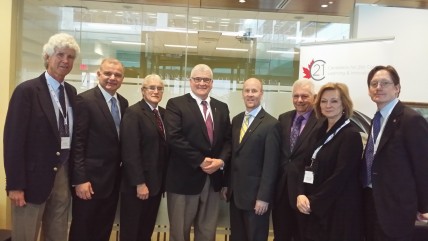
20140409_012850


L-R: David Roberts, C21 Canada; Robert Martellacci, C21 Cansda; John Kershaw, C21 Canada; David Dorward, MLA – Edmonton Gold Bar; Hon. Jeff Johnson, Minister of Education Alberta; Gord Hanna, Calgary Chamber; Naomi Johnson, former Chief Superintendent, Calgary Board of Education; and Andrew Parkin, Director General, CMEC

The 21st Century learning movement is gaining strength in Canada, although many staunch advocates will debate the depth of commitment. With the release of Achieving Excellence on April 7th Ontario joins British Columbia and Alberta incorporating 21st century competencies (e.g. creativity, critical thinking, entrepreneurialism, collaboration, communication, digital literacy) into their curricula.

Achieving Excellence also commits to enhancing the province’s level of investments in technology for learners and teachers; time will tell what these commitments entail in terms of classroom resources. The 1:1‎ student to computer model remains the nirvana of true 21st Century learning believers, whether this model is achieved through the “bring your own device” approach or through the government’s public provision of the tool, a far more expensive option for taxpayers.  Personalized access to information on the internet for students would more closely mimic today’s reality outside of the classroom so the call for individualized access is growing. As the cost of such devices decreases the opportunity for ubiquitous technology access for learners and teachers grows. With this growth come both opportunities and challenges. One of the challenges of the teaching profession in this digital era is to educate students on how to discern what information on the internet is relevant, and real. The penultimate goal however is to encourage students to create new knowledge and be innovative with the plethora of information now available to them.

Alberta remains Canada’s leader in its commitment to substantive change in public education to ensure learning is relevant to its students. The process of curricula renewal is comprehensive and inclusive of stakeholders outside the system.‎ A review of teacher competencies to align with the plan will soon be released and while contributing to Alberta’s Inspiring Education plan for education could also prove a significant contribution to other provinces and territories.

On April 8th Jeff Johnson, Alberta’s Minister of Education and current Chair of the Council of Ministers of Education Canada (CMEC) chaired a Roundtable of business leaders in Calgary. Co-hosted by C21 Canada, Calgary Chamber, Calgary Board of Education and CMEC, the Roundtable was designed to provide Minister Johnson with input on priorities for Canada’s learning and skills agenda, in his role as CMEC’s chair. Participants complimented Johnson on his vision for education, urged him to hold the course, and highlighted that a priority their companies was to find people proficient with the soft skills (i.e. 21st century competencies). Minister Johnson noted that it was his seventh such event and the call for education to embrace the teaching of 21st century competencies has been a constant theme. The views of the Calgary business delegates to the Roundtable echoed the findings of a recent survey of its members by the Canadian Council of Chief Executives. The survey clearly demonstrated that soft skills trumped technical knowledge as the attributes Canada’s senior executives considered essential from an employability perspective.

Nova Scotia will likely be the next province to join the 21st Century learning journey in Canada. The province’s new government has launched a major overhaul of its public education systems and has appointed to panel to assist the process. The Province is also seeking a new Deputy Minister to guide them ‎in designing a 21st Century model of learning.

Meanwhile, the topic of 21st Century learning ‎has become the centre of political debate in New Brunswick, once the recognized leader in Canada’s 21st Century learning movement. The Opposition Liberals have begun questioning the Conservative government’s decision on why they have failed to produce a plan for public education after four years in government. During a recent Question Period the Liberal education critic questioned the current Minister of Education on why the Conservatives abandoned the provinces 21st Century learning agenda entitled NB321C: Creating a 21st Century Learning Model of Education.

The Liberals are arguing that the government has been too preoccupied with the theme of inclusion, to the exclusion of all other education priorities. It is clear that the political battle lines are being drawn in New Brunswick for the impending fall election.

The fact remains that the 21st Century learning model ‎is now centre stage in the political and public discourse on public education in Canada. With declining levels of student engagement, the benefits of digital learning, the demand for people with soft skills, and a growing recognition that 21st Century learning model is more aligned with the social and economic realities of the knowledge and digital age, the advancement of this new model in Canada will undoubtedly continue.

The issue is whether Canada is able to keep pace with other countries in positioning its youth for success in the knowledge and digital age, and whether the public will provide politicians with the social license to be bold and undertake the level of transformation required. Clearly, engaging the public in the debate on why change is required and what needs to be done is the only way this is going to happen.

John Kershaw
President
C21 Canada
Filed Under: Blog, CMEC/ C21 Canada, Events

April 1, 2014 by admin

New Ontario Study Calls for Provincial Digital Learning Strategies

Is the Digital Divide Impacting the Skills and Employment Gap Amongst Our Youth?

By Robert Martellacci, Co-founder and Vice-president, C21 Canada

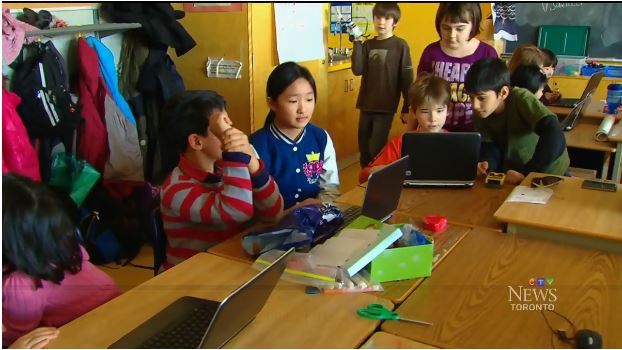
It was a fascinating opportunity to participate in the People for Education: Digital Learning in Ontario Schools – The New Normal news conference yesterday at Queen Elizabeth P.S. in the TDSB. One of the highlights of the morning was observing grade 4 students highly engaged in small teams collaborating with technology; blogging, creating websites and programming Lego Robotics. This is the “New Normal.”

CTVsnap

The challenge facing schools in Ontario is scaling Mr. Kiel’s grade 4 class beyond the pilot mode and into the mainstream classroom, thus getting beyond pockets of innovation. While the study acknowledges greater access to technology and free digital resources, Ontario has yet to announce its long awaited digital strategy framework which may be in part due to the rumoured provincial election.  In the meantime, school districts face the challenge of addressing the equity issue around technology access for students and teachers. BYOD (Bring Your Own Device) policies should help address this, however, a clear and concise vision from the Ontario Ministry of Education backed up with the infusion of funding will be most welcomed by parents, students and teachers alike.  Industry also has a role to play in forging strategic partnerships with education when it comes to providing cost-effective and appropriate digital resources and tools.

IMG_9399
(Left to Right) Robert Martellacci, Vice-president & Co-Founder C21 Canada, Annie Kidder, Executive Director, People for Education, Kelly Gallagher-Mackay, Research Director, People for Education

Kudos to People for Education for illuminating the “New Normal” in public education in Ontario. Innovation is no longer an option in preparing Ontario’s learners and future leaders for the 21st century global digital world. The education ecosystem needs to be nurtured by all to stakeholders to level the playing field with technology enhanced learning in order for Ontario to be a global leader and strive for excellence. It takes a connected digital village to raise a child in the 21st century.

Filed Under: Blog, Member News, Uncategorized

March 20, 2014 by admin

Ontario Highlights Education as Foundation of Future Economic Success

On March 18th, 2014 Ontario’s Premier Kathleen Wynne convened over 200 education and business leaders in Toronto to discuss the topic Talent and Skills in the New Economy. Interested readers can find commentary at #ONjobs.

The focus of the event was clearly post secondary education, with most participants hailing from Ontario’s university and college systems. A limited number of business leaders were also present, largely as part of the three panels.

While the keynotes and panels varied in focus, the central theme was how best to position Ontario in the 21st century knowledge economy. Premier Wynn’s speech was the event highlight, and her passion for education as the vehicle to reposition Ontario as the economic power in Canada was clearly evident. The Honourable Brad Duguid, Minister of Training, Colleges and Universities, shared the Premier’s passion and assuming the current government remains in power, Ontario’s focus on and investments in education will likely continue at a brisk pace.

Notwithstanding the post secondary focus, the majority of speakers highlighted the fact that the K-12 system in Ontario was an essential element to future success. In this context, perhaps it was unfortunate that the K-12 system was not more in evidence at the event. Although the Honourable Liz Sandals, Minister of education for Ontario was in attendance for a short time, the event was clearly a post secondary show. Fortunately, a number of speakers highlighted the fact that as a feeder system to the post secondary system, nurturing of the talents and skills required in the new economy must start in the early grades.  Premier Wynn acknowledged these observations when she noted that it is far too late to start talking about innovation at Grade 12.

According to public education officials, Ontario’s eagerly awaited vision statement (strategy) on its K-12 public education system is near completion. If Minister Sandals’ ongoing public statements are any indication, Ontario will soon join Alberta and British Columbia with a public commitment to a 21st century model of learning. However, this is not to say that Ontario is trailing these other two provinces in transforming its system. Large investments have already been made by the province in prototyping and evaluating what the changes would look like in advance of a public and systemic call for change. The outcomes of these investments will hopefully be released in a report in early spring.

If all speakers at Premier Wynn’s event had one thing in common it was recognition that if Ontario was to position itself for success in the global knowledge economy, unified action is required. Premier Wynn committed to reconvene the participants in three months time to continue the dialogue. Hopefully the next event will allow for more active engagement by participants in identifying the way forward. There was a lot of talent in the room, with many participants eager to contribute to building the strategy and framework to match Premier Wynn’s vision.  We would also encourage the organizers to bring together representatives from both Ontario’s K-12 and PSE communities, as both are as essential as the other in moving a 21st century learning agenda forward.

It is also clear that a growing number of provinces are actively pursuing learning and skills strategies rooted in the vision and principles of the global 21st century learning movement.  C21 Canada continues to call on CMEC Ministers to show national leadership and issue a vision statement calling on all provincial and territorial jurisdictions to modernize their public education systems consistent with the 21st century learning model. We recognize that provinces and territories will find their own way forward on this path, but it would help if Canadians were told that CMEC Ministers shared a vision for the future.  It would also serve to support those provinces and territories brave enough to move forward, and encourage the others to move in the same direction.

As noted at the event by Pat Horgan, Vice President of Manufacturing, Development and Operations for IBM Canada, we can all decide to work collaboratively, or all be outcompeted in the global marketplace.


Filed Under: Blog

March 11, 2014 by admin

21st Century Learning in the Media

The 21st century learning debate has finally gone public in Canada.

In one corner we have those Canadians who question whether our nation should stick to the 19th century inspired “industrial model” of learning. Hats off to Margaret Wente for articulating this point of view.  Wente’s article, published in the Globe and Mail March 4th 2014 likely reflects many Canadian’s concerns with what she calls the “the faddish, fuzzy notion called “21st Century Learning.”

Meanwhile, in Alberta, the Minister of Education, the Honourable Jeff Johnson, is championing what he calls “an informed transformation” of that province’s education system to a “21st century model of learning”.  Entitled “Inspiring Education”, the Alberta learning agenda embraces the principles of the 21st century learning movement. In an article published March 5th 2014 in the Calgary Herald Minister Johnson highlights the rationale for the changes and points out the fallacies of those suggesting Alberta is risking their “international success status” in student performance.

We applaud both Wente and Johnson for taking on this important debate. Of course, as an organization whose mandate is to advocate for 21st century models of learning through-out Canada, C21 Canada is clearly on Johnson’s side of the argument. However, we welcome Canadians engagement on the fundamentally important question of the future of education in Canada.

The critical question Canadians must ask themselves is: “Will the industrial model of learning, developed in the 19th century, continue to serve young Canadians and the country, or do we need to modernize our model of learning to reflect 21st century realities?”

The second question we must ask is: “Is 21st century learning really a “faddish, fuzzy notion?” In 2012, C21 Canada released “Shifting Minds: A 21st Century Vision of Public Education for Canada”. Shifting Minds is founded on a vast array of both national and international research and offers a vision and framework for Canadians to understand “why” a 21st century learning model is needed in today’s knowledge and digital era,  “what” constitutes a 21st century learning model, and “how” to make the changes required. The OECD, UNESCO, European Union and Partnership for 21st Century Skills in the United States are just some of the international organizations calling for countries to modernize their learning systems. And many jurisdictions are responding, including some of the top PISA performing countries in the world. A growing number of thought leaders around the world are joining the call for change and much has been written on what has been coined the global 21st century learning movement.  Interestingly, within this growing body of knowledge, there is a high convergence of thinking around what must be done to position today’s youth for success in “their” future. To suggest that the 21st century learning is a fuzzy, faddish notion is an injustice to the global research and evidence behind the principles and concepts.

If Wente and others are to continue to be the voice of maintaining the 19th century industrial model of learning in the 21st century in this country, we encourage all Canadians to become more informed of what this would really mean for our youth, and for Canada as a whole. If you believe the world around you has changed remarkably in the 21st century with the advancements of new technologies and access to the world’s body of knowledge, you may begin to wonder why our education systems should remain the same.

On February 19th, 2014 C21 Canada presented Minister Jeff Johnson with a Shifting Minds Award to recognize his work in advancing a 21st century model of learning in Alberta. While C21 Canada will likely never present Margaret Wente with a Shifting Minds Award, we appreciate her contribution to the debate on whether education in Canada needs to be modernized. In our view, this debate needs to be public, and is the most important topic Canadians should be engaged on at this time.

Filed Under: Blog

February 24, 2014 by admin

Inspiring Education Symposium in Alberta

This week’s Inspiring Education Symposium in Alberta showcased a province with a clear vision and a committed leadership to an informed transformation of its education system. Convening 1200 educators in Calgary, the Alberta Minister of Education and his team offered presentations and workshops and welcomed feedback on the province’s Inspiring Education agenda. Andreas Schleicher of the OECD offered delegates an insightful overview of the OECD’s research on student and adult competencies that can be viewed at: http://education.alberta.ca/department/ipr/inspiringeducation/inspiringeducationsymposium.aspx.

Rooted firmly in 21st century learning principles the province’s education strategy is designed to position Alberta’s youth with the competencies and skills they will need for success in today’s innovation driven society and economy. Redesigning curriculum, investing in learning technologies, and reviewing teacher competencies are all part of the mix. Alberta is also being smart by creating innovative models of collaboration among both educators and stakeholders outside the system to get these jobs done.

On the same day as Alberta was hosting its symposium, ‎the Nova Scotia government declared its intent to overhaul and modernize its education system. ‎In announcing the panel that will oversee the review, Karen Casey, the NS education minister declared that “The government is committed to a new direction for the education system.” Given that government’s search for a new deputy minister of education highlights the need for the province to engage in the 21st century learning movement, it appears Nova Scotia is poised to join Alberta on the 21c learning journey.

We are, in fact, beginning to witness a trend across Canada. BC is redesigning it’s curriculum to infuse 21st century competencies into its curriculum, Alberta is well into implementing Inspiring Education and Ontario is on the verge of announcing a new education plan.

In Ontario, the Ontario Public School Board Association released A Vision for Learning and Teaching in a Digital Age, calling for the province to launch an education strategy reflecting the knowledge and digital reality of the 21st century. If Minister Liz Sandals’ recent public remarks on needing to infuse 21st century competencies into Ontario’s curriculum, the OPSBA are likely to get the plan they desire.

This would mean three of Canada’s top performing provinces on international assessments of student (PISA) and adult (PIAAC) competencies have determined that being atop an old paradigm of learning is not good enough. They are in fact acknowledging that the knowledge and digital age has ‎shifted the societal and economic ground under their feet, and education needs to be shifted in response.

The OECD, UNESCO, the European Union, Partnership for 21st Century Skills and a growing array of global thought leaders have been calling for the informed transformation of public education for some time. C21 Canada was created in 2011 to advocate for modernizing Canada’s education systems and released Shifting Minds, a vision and framework for public education in this country that reflects Canadian values and principles (www.c21caanda.org).

 A number of jurisdictions around the world have already responded to the multiple calls for change, notably Singapore, Finland and New Zealand. And now, some of Canada’s provinces are finally beginning to join the 21st century learning movement.

In Nova Scotia, the new government ‎received an economic wake-up call from the NS Commission Nova Scotia Commission on Building Our New Economy. The Commission’s report, coupled with the government’s announcement on modernizing the NS learning agenda, is a breath of fresh air in the Maritime, where weak economies and declining government revenues have people talking about bold new solutions and the nurturing and pursuit of knowledge sector opportunities. Connecting the dots between pursuing an innovation rich economy and redesigning education systems and investing in learning technologies to nurture the talent to create and support innovation is unfortunately still elusive for some politicians. In New Brunswick, once at the leading edge of the 21st century learning movement in Canada, ‎many are awaiting the fall election to see if the current malaise in education and preoccupation with inclusive education will continue, or whether a new government will breathe renewed life into the educators ‘mothballed 21st century learning agenda NB321C‘.  (http://www.youtube.com/watch?v=bDM3D4MNQBs).  As one New Brunswick education official noted at a recent national conference “We were leading the 21st century learning parade. Now we are on the sidelines watching the parade pass us by.”

At the pan Canadian level there are hints that the Council of Ministers of Education Canada (CMEC), under the enlightened chair of 21st century learning believer Jeff Johnson (Minister of Education for Alberta) will soon pronounce itself on the need for all provinces and territories to collaborate in the modernization of Canada’s learning systems. A statement from CMEC would certainly breathe life into those jurisdictions struggling to find their own 21st century inspired vision for education.

C21 ‎applauds jurisdictions serving their youth by modernizing their education systems. At the Alberta Inspiring Education symposium held February 19 C21 surprised Minister Jeff Johnson with a Shifting Minds Award to recognize his leadership in Alberta. C21 also remains hopeful that Minister Johnson will lead a pan Canadian effort as Chair of CMEC.

The 21st century learning movement is global in nature, and the old adage about you can pay me now or you can pay me later applies. We are in a 21st century skills race, a position supported by a report commissioned by the Canadian Council of Chief Executives. Much like the Olympics, those countries that invest in nurturing talent will see the results on the podium. Except in this case we are talking about giving our youth the skills they need for their future, and the podium is our collective future prosperity as a nation.

C21 Canada would also like to take this opportunity to extend our congratulations to all the athletes, their coaches, families and friends who represented Canada so well at the Sochi Olympic Games!

Filed Under: Blog

  • « Previous Page
  • 1
  • …
  • 18
  • 19
  • 20
  • 21
  • 22
  • …
  • 28
  • Next Page »

Profile

C21 Canada and its members provide collaborative vision and support to help Canadian education organizations enhance learning in the foundation areas of literacy, numeracy and science while infusing 21st Century skills (creative problem solving, critical thinking, collaboration, communication, personal development, global citizenship and digital competency) into content, and instructional and assessment practices.

Creative Commons

Creative Commons License

This work is licensed under a Creative Commons Attribution 4.0 International License.

Stay Connected

Search

Copyright © 2026 — C21 Canada • All rights reserved.