C21 Canada

  • Home
  • About C21
    • Organizational Goal
    • Press Releases
    • Advisory Council
    • Secretariat
    • CEO Academy
    • CIO Alliance
    • Get Involved
    • Contact
  • Partners
  • Blog
    • C21 Canada Webinar Series: Future of AI in K12 Use Case Project Leadership Insights
    • C21 Canada Webinar Series: The Future of AI in K12 Education
    • C21 Canada 10th Anniversary Webinar Series
    • C21 Canada 2020/2021 School Year Podcast Series
  • Curation Space
    • CEO Academy Login
    • C21 Board Login
  • C21 Canada Publications
    • C21 CANADA AI TASKFORCE REPORT
    • The Future of AI in K12 Education Report
    • School Beyond COVID-19
    • C21 Canada Research
    • Resources
    • Parent Guide
    • Spiral Playbook
    • Shifting Minds
    • A COVID-19 LEADER PLAYBOOK FOR SURVIVING AND THRIVING
  • AI Use Cases
    • Spring 2025
    • Fall 2024

October 3, 2013 by admin

Creating a 21st Century Learning and Skills Agenda

By John Kershaw, President of C21 Canada and the former Deputy Minister of Education for New Brunswick.

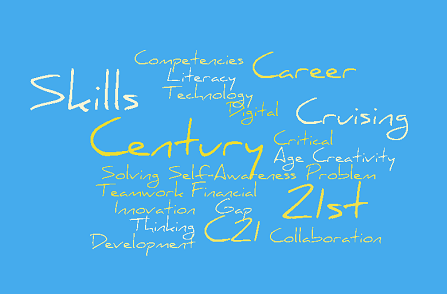
word_map3_21st_century_skills
In today’s innovation driven and competitive world, highly skilled people are the new economic and social drivers. In this context, there are two core questions facing leaders in Canada and the United States:  How to nurture creative and innovative talent; and how to address the current skills gap. Along with C21 Canada, Career Cruising is poised to play an important role on both fronts.

In the knowledge and digital age value added knowledge creationdrives innovation. Thus, the demand for creative and innovative people is escalating and is emerging as one of the key elements of the global skills gap.  C21 Canada is a national coalition of education and business leaders advocating for changes in Canada’s public education systems to address this reality. OurShifting Mindsvision document calls for an enhanced focus on 21st century competencies and use of modern technologies to position Canada with creative new leaders and a highly innovative workforce. The Partnership for 21st Skills is active on this same front in the United States (http://www.p21.org/).

Better understanding the complexities of the skills gap is a prerequisite to collaborative action. Despite its growing public profile, few fully understand the nature and scope of the issue. In addition to fostering the aforementioned 21stcentury competencies, other elements of the skills gap are noted below.

In his book People Without Jobs Jobs Without People Rick Miner explains how Canada’s aging demographic means fewer people available for the workforce, creating a gap in available talent for employers. Exacerbating this issue is the relatively low literacy levels of some workers, limiting their ability to upgrade their skills to stay current with changing work requirements.

A gap also exists in the field of trades, partially resulting from many parents and educators discouraging youth from pursuing this career path. Mike Rowe, a popular actor in the United States, is speaking extensively on this topic and hasfounded an organization to address the issue.  Fewer entries into trades coupled with baby boomers retiring are creating a gap between supply and workforce requirements.

Similarly, too few youth are pursuing the fields of science, technology, engineering and math (STEM). Most of society’s technology innovations originate in these fields and increasing the number of STEM students is a prerequisite to any country’s future competitive position.

On October 8, 2013 the OECD will release the findings of its inaugural international survey on adult competencies. The survey will provide an unprecedented glimpse into whether the participating countries are equipping their citizens with the competencies and skills they need for success in the 21st Century.

What does this all mean?  It means that what we teach, how we teachand how we assess learning,must change. It also means we must do a better job of educating people of all ages about career opportunities and how to adapt in a world where innovation is creating a complex and constantly shifting environment.  C21 Canada is building awareness of the need for more relevant and engaging models of learning and Career Cruising is offering a suite of programs and services designed to better align people’s interests with existing and emerging careers.  If we are successful on both fronts, instead of suffering through an ongoing skills gap we will instead create a learning and skills agenda for the 21st Century.

Read more here.

Filed Under: Uncategorized

October 2, 2013 by admin

John Kershaw of C21 Canada on The Agenda with Steve Paikin

CaptureJohn Kershaw of C21 Canada appears on The Agenda with Steve Paikin: Learning 2030: Disengaged and Excluded

Live from the Perimeter Institute in Waterloo, Ontario, The Agenda asks: Who are the students who get the least out of the existing educational system? Will a radical reform of the educational system that is driven by technology change that level of engagement? The first in a five-part examination of future learning at the Equinox Summit: Learning 2030.

Click here to watch.

Filed Under: Uncategorized

October 1, 2013 by admin

C21 Canada’s Robert Martellacci Featured in BackBone Magazine

backbone-digital-magazine-2013-09New Thinking for a New Education System

By Robert Martellacci, President and Publisher, MindShare Learning

With back to school upon us, there’s an immense buzz around the promise of mobile computing and tablet technology making its way into many Canadian classrooms. While there are many pockets of innovation, the challenge lays in the fact that education systems across Canada remain largely antiquated, lacking proper funding and unable to absorb today’s leading-edge technology. The lack of professional development has created a lost generation of teachers who are most comfortable with the tools of yesteryear.

The Canadian EdTech Leadership Summit, presented by MindShare Learning on Nov. 5, takes place at the MaRs Innovation Centre. This year’s theme is “Beyond Pockets of Innovation,” inspired by the fact Canada has been lagging behind when it comes to innovation in preparing our future leaders with the essential skills to compete in the 21st century global knowledge-based economy.

We have an alarming skills gap. The Conference Board of Canada estimates this gap is costing the Ontario economy up to $24 billion annually. This presents a challenge and opportunity for industry to partner with education and government to create a more tightly aligned ecosystem. We need to take a bold stance as a country to declare our innovative spirit, as is being proposed by C21 Canada, Canadians for 21st Century Skills and Innovation.

Why bother? What’s crystal clear is that we have a generation of students who are graduating from high school with no vision for where they’re going. I come across many parents whose kids are taking a “gap” year because they are not sure what they want to do with their lives. Isn’t that what university is about, to explore the arts, humanities and social studies or sciences?

Recently, I spent part of a weekend as a mentor at the Startup Weekend Toronto EDU event. Youths formed teams that created technology solutions, and companies addressed many of the challenges that education faces today. Question: What happens when you engage future leaders with diverse backgrounds such as engineering, computer sciences, designers, marketing and business students in one room? This is where the magic happens. Teams created solutions such as parent communication tools, personalized scholarship search engines, and virtual fieldtrip tools, to name just a few. What fascinated me as an entrepreneur and parent was the creativity and problem-solving and communications skills that emerged from each of the teams; they walked the digital talk, and they were having fun too. Isn’t that what school should be nurturing?

Being part of Startup Weekend Toronto Edu was special for me. It opened my eyes to how vital it is to create and nurture innovation hubs in schools, towns and cities where all Canadians can be inspired to solve challenges, hone their skills to discover their passion and make a valued contribution to our country.

I recently took on an intern student from a local college. I think I learned as much from the experience as she did. Understanding our youth and providing them with opportunities to explore, learn and grow is critical to nurturing their future success. It takes a digital village of stakeholders from business, education and government to nurture and help chart a course for our next generation of leaders. I’m all in! Are you?

SEE MORE HERE.


Filed Under: Uncategorized

September 12, 2013 by admin

C21 Welcomes New Member and Sponsor

As a part of the C21 mission to expand its national network we are pleased to announce our newest board member Naomi Johnson, Calgary Board of Education’s Chief Superintendent of Schools.

We would like to thank Warren Jestin, Senior Vice-President & Chief Economist at Scotiabank, for generously sponsoring and supporting C21 Canada.

NoamiJohnsonSmaller WarrenJestin

From left to right: Naomi Johnson, Calgary Board of Education’s Chief Superintendent of Schools
Warren Jestin, Senior Vice-President & Chief Economist at Scotiabank


Filed Under: C21 News, Uncategorized

September 11, 2013 by admin

The Hunt for 21st Century Learning

By John Kershaw, President of C21 Canada and the former Deputy Minister of Education for New Brunswick.

There is an intriguing scene in the movie ‘Zero Dark Thirty’ where the lead agent on the hunt for Osama Bin Laden decries the lack of action  by writing the number of days passing by on her manager’s office window. As we enter the 2013-2014 school year that specific scene reminds me of the pace of Canada’s efforts to offer Canadian learners a modern education experience relevant to their 21st century requirements.

Well, take note. On October 8, 2013 the OECD will be writing on Canada’s window. On that date the OECD will release the results of their international survey on “adult competencies.” The Programme for the International Assessment of Adult Competencies will provide an unprecedented glimpse into whether the participating countries and their respective learning systems are equipping their citizens with the competencies and skills they need for success in the 21st Century.

Allow me to offer two insights into what this inaugural international survey may mean for Canada.

First, it is safe to predict that the OECD findings will focus on literacy, but Canadians should not be surprised if the OECD’s definition of literacy differs greatly from the historical “ability to read”. In the knowledge era “literacy” means the ability to access, filter, digest, critically analyze, and create new knowledge from the information gleaned. The ability to be creative, innovative, collaborative and a critical thinker will likely also be referenced in this context. Furthermore, the OECD will include the capacity to use technology in this process.  C21 Canada is an education and business partnership advocating for Canada to modernize its learning systems to in part address this new literacy reality, and we are pleased to be witnessing pockets of  progress. However, the PIAAC results are anticipated to underscore the need for Canada to act more urgently on this front.

Second, the PIAAC findings will land in the midst of the growing debate on skills in this country. C21 Canada welcomes the focus on skills development because in today’s innovation driven world  highly skilled people are the new economic and social drivers.
As the “skills gap” gains public and political attention, virtually every economic and education organization is shifting their focus on the issue. The PIAAC findings will offer comprehensive data to augment the national discourse on this important topic.  What Canada needs however is a “coordinated” effort. We need federal and provincial agencies responsible for education and skills development to take the reins and coordinate Canada’s response. Most importantly, we need to look beyond the current “gap debate” and identify strategies and solutions for positioning Canadians and Canada for success in the future.

Perhaps most importantly we must understand that what happens in public education ultimately translates into “adult competencies” and “adult competencies” translates into “Canada’s human capital” and “Canada’s human capital” means our nation’s ability to fuel economic and social progress. Canada’s future success therefore is hugely dependent on connecting the dots and modernizing our public learning systems to the realities of the knowledge and digital age.

This fall, the Minister of Education for Alberta takes over the reins of the Council of Ministers of Education Canada (CMEC). Alberta is arguably Canada’s foremost leader in transforming its education system to a 21st Century model of learning, and we hope the Honourable Jeff Johnson will infuse CMEC with the same spirit of leadership on this front. For example, infusing 21st century learning principles into CMEC’s Learn Canada 2020 strategy would be a significant show of national leadership.

As the OECD “writes on Canada’s window”, C21 Canada for one will be writing on Minister Johnson’s window and offering him support as he guides CMEC’s efforts toward modernizing Canada’s education systems and designing a pan-Canadian skills agenda for the 21st Century.

Filed Under: Uncategorized

  • « Previous Page
  • 1
  • …
  • 33
  • 34
  • 35
  • 36
  • 37
  • …
  • 42
  • Next Page »

Profile

C21 Canada and its members provide collaborative vision and support to help Canadian education organizations enhance learning in the foundation areas of literacy, numeracy and science while infusing 21st Century skills (creative problem solving, critical thinking, collaboration, communication, personal development, global citizenship and digital competency) into content, and instructional and assessment practices.

Creative Commons

Creative Commons License

This work is licensed under a Creative Commons Attribution 4.0 International License.

Stay Connected

Search

Copyright © 2026 — C21 Canada • All rights reserved.